Notes on: Emotional Intelligence Has 12 Elements. Which Do You Need to Work On?
- Jon Vassallo

- Apr 28, 2022
- 3 min read
'Emotional Intelligence Has 12 Elements. Which Do You Need to Work On?' is an article by Daniel Goleman and Richard E. Boyatzis and was originally published on hrb.org.

Some people have a limited view on what EI (emotional intelligence) refers to. For them, someone who is kind, respectful, maintains a positive outlook, controls their emotions, is a good listener and is sensitive to the needs of others can tick the EI box off and move along, but there is more to EI than that.
Having too narrow a definition of emotional intelligence can limit your ability to excel further as a leader or even in your personal relationships. Sociability, sensitivity and likability are essential parts of having a strong EI, but there are other skills, like the ability to deliver difficult feedback to friends or colleagues, the courage to incite change, and the creativity to solve problems, that can enable you reach your full potential. Having a well balanced variety of specific EI skills actually prepares people to handle tough situations better.
EI, as defined by Goleman and Boyatzis, has four domains:
Self awareness
Self management
Social awareness
Relationship management
Within each of these domains are twelve EI competencies they have defined, which are both learned and learnable, that foster the best performance at work and impact personal relationships positively.
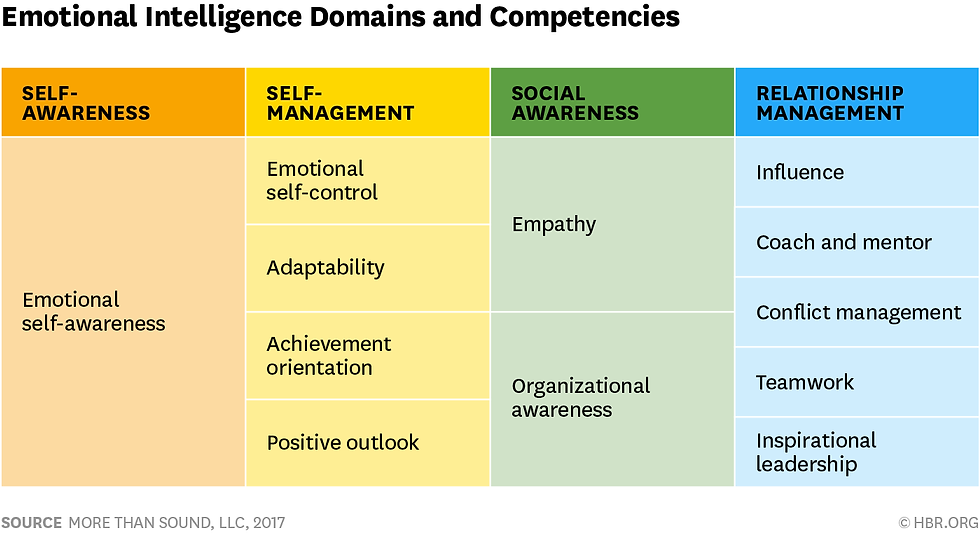
These competencies include the typical skills we associate with EI, like empathy and self control, but they also include influence, conflict management and teamwork, which require use of emotions to be effective as well.
For example, if someone had a peer who incited negative emotions in others, they could simply try to intervene and calm the situation down, which is one way of using some of the EI skills, or they could bring up the issue with their peer directly, in a way where they control their emotions, helping them realize the err of their way that comes from a place of wanting them to be more successful.
In order to excel, as a leader or even in our personal relationships, we need to develop a balance of all the EI competencies. When we do that, we get better results.
How can you tell where your EI needs improvement — especially if you feel that it’s strong in some areas?
Simply self-assessing the 12 competencies by yourself can give you a sense of where you might need some development. Just take the time to go over each one and reflect and give yourself an honest review.
There are also comprehensive 360-degree assessments, which include assessments and reviews by peers as well. This external feedback is particularly useful for capturing blindspots in self-awareness. You can approach peers at work or in your personal life to help you get a sense of where you are. The more people you ask, the better a picture you get, but it has to people that know you well enough.
In the workplace there is also more formal 360-degree assessments, which include anonymous observations of your behaviour by people who work with you, such as the Emotional and Social Competency Inventory, or ESCI 360.
A big gap in how one perceives themselves versus how they are perceived by others suggests they have fewer EI strengths, and this is shown in strained work and personal relationships.
Just by becoming aware and understanding that these 12 competencies are all a part of your emotional intelligence is a great foray to establishing the balance that will enable you to be more successful. However, having a coach help you navigate situations, especially ones that are emotionally charged, is the most effective way finding the best EI balance.
By limiting your perspective of EI, and assuming it is just about being happy-go-lucky, you are limiting your ability to truly thrive in your work and personal relationships.


A lot of times just trying to ‘smooth something over’ is an avoidance tactic and doesn’t really address the problem.